

Personal Trainer Qualifications UK: The Definitive 2026 Guide to Getting Certified
Gareth Luke posted this on Tuesday 8th of September 2026 Gareth Luke 08/09/2026
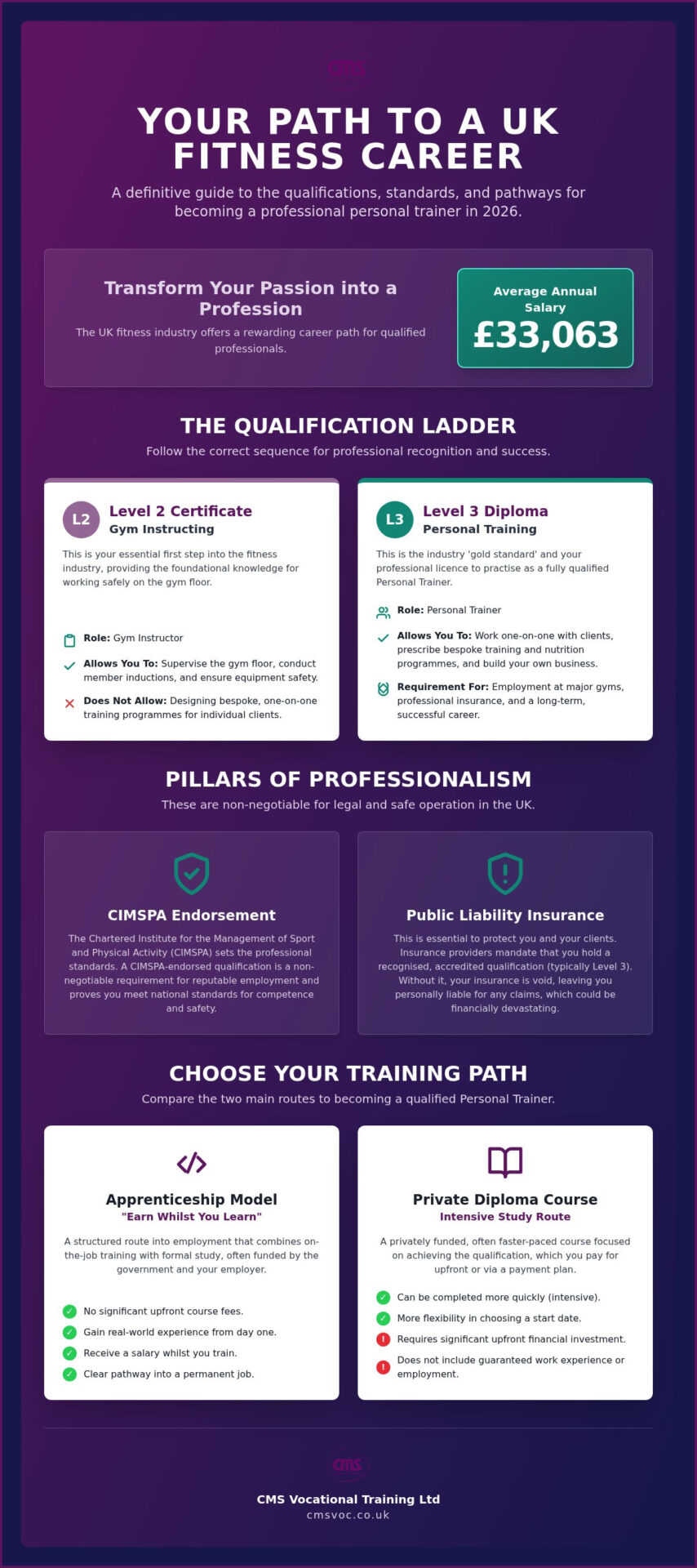
What if your passion for the gym could be transformed into a professional career earning an average of £33,063 per year? Many aspiring coaches feel held back by the confusing maze of personal trainer qualifications uk requirements, often worrying about high upfront costs or whether a specific course is actually accredited. It’s completely natural to feel hesitant when you’re faced with choosing between Level 2 and Level 3 certificates whilst trying to avoid providers that won’t help you gain employment at a reputable health club.
We understand that you want a clear, reliable path into the industry. This definitive 2026 guide promises to demystify the certification process, showing you exactly which qualifications you need to launch a successful fitness career. You’ll discover why the Level 3 Diploma remains the gold standard for entry and learn about “earn whilst you learn” apprenticeship options that remove financial barriers. We’ll explore essential CIMSPA standards and provide a step-by-step plan to get you certified and ready to inspire your first clients.
Key Takeaways
- Understand why CIMSPA-endorsed certifications are a non-negotiable requirement for legal operation and insurance coverage in the UK fitness industry.
- Distinguish between Level 2 and Level 3 requirements to ensure you’re following the correct sequence for professional recognition.
- Compare the different personal trainer qualifications uk pathways, including intensive private diplomas and government-funded apprenticeship models.
- Explore the benefits of the “earn whilst you learn” approach, which provides a structured route into employment without significant upfront costs.
- Gain a clear step-by-step plan for choosing a training partner that prioritises your long-term career development and practical skill mastery.
Understanding Personal Trainer Qualifications in the UK
Entering the fitness industry is an exciting step, but it requires more than just a passion for lifting weights or running marathons. In the United Kingdom, a professional qualification acts as your licence to practice. It ensures you have the anatomical knowledge and coaching skills to keep clients safe. When researching UK personal training qualifications, it’s clear that these certifications are the only way to prove your competence to both employers and insurers. Whilst the industry is technically self-regulated, you’ll find that the “wild west” era of coaching is long gone.
Social media has created a rise in self-taught fitness influencers, but there is a massive difference between having a following and being a professional. You cannot legally or safely operate in most reputable UK gyms without the correct personal trainer qualifications uk standards. Gym owners require proof of certification to meet their own health and safety obligations. Without these credentials, you’re essentially a hobbyist rather than a professional coach.
The industry foundation is built on two distinct “fitness levels”. Level 2 serves as the entry point, qualifying you as a Gym Instructor. This allows you to work on the gym floor and lead basic inductions. However, to work one-on-one with clients and prescribe bespoke training programmes, you must achieve Level 3. This progression ensures you have a solid grasp of the basics before moving into complex client management.
The Legal and Insurance Requirements for UK Trainers
Public Liability insurance is non-negotiable for anyone working in fitness. It protects you if a client suffers an injury or if equipment is damaged during a session. Insurance providers are very specific about who they cover; they mandate that you hold a recognised qualification from an accredited body. If you attempt to train clients with an unrecognised or “fast-track” online certificate that lacks practical assessment, your insurance will likely be void. This leaves you personally liable for any claims, which could be financially devastating. Most providers use your qualification level to determine the scope of your coverage, making the Level 3 Diploma the essential benchmark for full protection.
Why Professional Certification Matters in 2026
In 2026, clients are more discerning than ever. They want to know that the person they’re paying for health advice is actually qualified to give it. Professional certification builds immediate trust and sets you apart from the noise of the internet. Furthermore, holding a recognised qualification is the only way to gain access to employment in major gym chains. These organisations have strict vetting processes and will only hire trainers who meet national standards. A Level 3 Diploma in Personal Training serves as the definitive gateway to professional registration and a career with genuine longevity.
Level 2 vs Level 3: Which Qualification Do You Need?
Understanding the distinction between these two tiers is vital for your career progression. Many newcomers ask if they can jump straight into a personal training role, but the structure of personal trainer qualifications uk requires a stepped approach. You should view Level 2 as your foundational entry point and Level 3 as your professional licence to operate independently. One is not an alternative to the other; rather, they form a continuous learning journey that prepares you for the complexities of the modern fitness landscape.
The National Careers Service highlights that whilst both levels are essential, they offer very different career outcomes. A Level 2 certificate qualifies you to work as a Gym Instructor, whereas the Level 3 qualification is the minimum standard required to prescribe bespoke exercise programmes and manage your own client base. If your goal is to earn the average 2026 salary of £33,063 or build a self-employed business, you’ll certainly need to achieve that Level 3 status.
The Level 2 Certificate in Gym Instructing
This qualification serves as the essential first step for every fitness professional. The core modules focus on the fundamentals of anatomy and physiology, alongside the practical skills needed to support clients in a gym environment safely. As a Level 2 Gym Instructor, your role is primarily focused on gym floor supervision, equipment inductions, and ensuring a safe training space. You’ll learn how to maintain a professional environment and assist members with basic exercise technique. It’s important to remember that this certificate does not permit you to design individualised, long-term training plans for clients; it provides the base knowledge you need before tackling more advanced concepts.
The Level 3 Diploma in Personal Training
To move into one-to-one coaching, you must progress to the Level 3 Diploma. This course delves into advanced topics such as nutrition for physical activity, programming for specific client goals, and the business skills required to thrive in a competitive market. It prepares you for the commercial reality of being a trainer, covering everything from lead generation to hybrid coaching models. The Level 3 Diploma is the industry benchmark for professional competence. It signals to employers and clients that you possess the expertise to deliver results safely and effectively. If you’re looking for a supportive environment to gain these skills, you might consider starting with a Level 3 Diploma in Personal Training to ensure you’re fully prepared for the workplace.
The Role of CIMSPA and Professional Standards
When you start looking at personal trainer qualifications uk, one acronym will keep appearing: CIMSPA. The Chartered Institute for the Management of Sport and Physical Activity (CIMSPA) is the professional development body for the UK’s sport and physical activity sector. They don’t just set the rules; they provide the framework that ensures every trainer meets a high standard of professional competence. In 2026, being a member isn’t just a “nice to have”, it’s the industry expectation. For a small annual fee of £38.94, or just £3.24 per month, you gain the professional recognition that major employers demand.
Professional standards are designed to protect everyone involved. They ensure you have the right knowledge to train the public safely, whilst also protecting your reputation as a coach. The “Chartered” status is particularly significant as you progress your career. It elevates your role from a simple instructor to a recognised professional, putting you on the same level as other chartered occupations like accountants or engineers. This status demonstrates your commitment to excellence and ongoing development, which is vital for building a long-term career.
What Does CIMSPA Endorsement Mean for Your Course?
Not all courses are created equal. When a provider is CIMSPA-endorsed, it means they’ve gone through a rigorous vetting process to prove their curriculum meets national occupational standards. Whilst many courses claim to be “accredited” by an awarding body, “endorsed” means the professional body itself has approved the specific training delivery. This ensures your qualification is recognised by all major UK employers, from large gym chains to boutique studios. It’s the difference between having a piece of paper and having a respected professional credential that guarantees your employability.
The Benefits of Professional Recognition
Gaining recognition opens doors that would otherwise remain closed. You’ll gain access to the CIMSPA member directory, which increases your visibility to potential employers and clients looking for verified professionals. To maintain your status, you’ll need to engage in Continuing Professional Development (CPD). This isn’t just a box-ticking exercise; it’s a way to stay relevant as trends like hybrid coaching and specialist populations evolve. You’ll also find yourself amongst the UK’s leading fitness professionals, offering networking opportunities that can lead to career-defining partnerships and growth.
Choosing Your Path: Apprenticeships vs Private Diplomas
Deciding how to obtain your personal trainer qualifications uk depends largely on your current lifestyle and financial situation. You’re faced with two primary choices: the fast-paced private diploma or the comprehensive apprenticeship route. Both lead to the same Level 3 standard, but the journey and support structures differ significantly. Choosing the right path is about finding the balance between speed and depth of experience.
Private courses are often described as “intensive” because they condense a vast amount of theory and practical work into a few months. In contrast, the apprenticeship model is a marathon rather than a sprint. It allows you to embed your learning over a longer period, ensuring you feel truly confident before you start charging for your services. Both routes are valid, but they suit different types of learners and career goals.
The Personal Training Apprenticeship Route
An apprenticeship is a steady, long-term model typically lasting 12 to 18 months. It allows you to “earn whilst you learn”, providing a structured way to enter the industry without the pressure of upfront training costs. This path combines the Level 3 Diploma with daily work experience in a gym environment. You gain a mentor who provides steady, practical guidance, helping you apply theory to real clients immediately. In 2026, funding is often available for those starting their career or moving into a new role within the fitness sector, making it an accessible entry point for many.
Private Vocational Diplomas: Speed and Flexibility
Private vocational diplomas offer speed and flexibility for those who want to launch their career as quickly as possible. These are often the preferred choice for career changers who need to get qualified whilst managing other commitments. Most reputable providers use a blended learning model, combining online theory with practical workshops. This allows you to balance your studies with an existing job. When choosing a provider, avoid “budget” options that lack in-person assessment. Look for established partners that prioritise your professional growth rather than just your course enrolment.
The financial difference is a major factor to consider. Private courses usually require an upfront investment, whilst an apprenticeship is government-funded and provides a steady wage. If you prefer a nurturing, hands-on environment where you can build confidence slowly, the apprenticeship is often the superior choice for long-term success. If you’re ready to take the next step, you can explore our Personal Training Apprenticeships to see which path fits your career goals.
Starting Your Fitness Career with CMS Vocational Training
Choosing where to obtain your personal trainer qualifications uk is a decision that shapes your entire professional future. At CMS Vocational Training, we’ve spent decades acting as a nurturing mentor for aspiring coaches, helping them bridge the gap between their current skills and a successful career. Established circa 1984, we’ve built a reputation as a steady, reliable guide in the professional landscape. Our approach is deeply supportive. We don’t just hand you a textbook and leave you to it. Instead, we invest in your personal growth, providing a structured pathway that prioritises practical skill mastery and long-term achievement.
We understand that the prospect of further education can feel intimidating. That’s why our “people-first” attitude starts from your very first enquiry. Whether you’re interested in personal training, customer service, or leadership, our team is here to help you navigate the various vocational pathways available. We aim to make the process feel achievable and inclusive; we ensure you have the support needed to transition from a learner into a competent, confident professional.
Our Level 3 Diploma in Personal Training
The CMS programme is designed to prepare you for the commercial reality of the 2026 fitness market. Our Level 3 Personal Training Diploma goes beyond the basic requirements of the syllabus. We focus on building a sustainable business, covering essential areas like client retention and hybrid coaching models that were discussed earlier in this guide. We believe that a qualification is only truly valuable if it leads to a thriving career. By choosing our diploma, you’re opting for a programme that balances scientific theory with the practical business skills needed to stand out amongst the competition.
Why Choose CMS for Your Fitness Apprenticeship?
As an apprenticeship delivery specialist, we have long-standing experience in matching talented individuals with the right gym environments. Our fitness apprenticeships are more than just a job. They represent a comprehensive educational experience. We ensure every apprentice feels supported through regular check-ins and expert mentoring. This nurturing environment allows you to develop your coaching voice whilst gaining the personal trainer qualifications uk employers value most.
Getting started is a straightforward process. You can begin by submitting an enquiry through our website to speak with one of our advisors. We’ll guide you through the application process and help you identify the best funding options for your situation. Our team is dedicated to finding a placement that aligns with your professional aspirations and sets you on a clear path to success.
Take the Next Step Toward Your Professional Fitness Career
Launching a successful coaching business in 2026 starts with a commitment to professional excellence. You now understand that whilst Level 2 provides the foundation, the Level 3 Diploma is the essential benchmark for anyone serious about the industry. By aligning with CIMSPA standards, you ensure your credentials carry the weight required by major employers and insurance providers alike. Whether you choose the flexibility of a private course or the immersive “earn whilst you learn” apprenticeship route, your focus should remain on gaining practical, real-world skills that deliver results for your future clients.
At CMS Vocational Training, we’ve been a steady, reliable guide for aspiring professionals since 1984. We provide a supportive, mentor-led environment that prioritises your personal growth alongside your academic achievement. Our CIMSPA-aligned training pathways are designed to help you navigate the complexities of personal trainer qualifications uk with quiet confidence and clarity.
Explore our Level 3 Personal Training Diploma and start your career today.
Your journey toward becoming an elite fitness professional starts with a single, well-informed step. We’re here to help you take it.
Frequently Asked Questions
What is the most recognised personal trainer qualification in the UK?
The Level 3 Diploma in Personal Training is the most recognised and industry-standard qualification for anyone looking to work as a professional coach. To ensure your credentials are valid, your course should be endorsed by CIMSPA. This endorsement guarantees that your training meets national occupational standards and is accepted by all major UK gym chains. It serves as your professional licence to prescribe bespoke exercise programmes and manage your own client base.
Can I become a personal trainer without a Level 2 qualification?
You cannot become a fully qualified personal trainer without first completing a Level 2 Gym Instructor qualification. This initial certificate provides the foundational knowledge of anatomy and physiology required to progress to more advanced training. Most providers offer combined courses that allow you to work through both levels sequentially. Starting with the basics ensures you have the competence to supervise a gym floor safely before you begin one-to-one coaching.
How long does it take to get a Level 3 Personal Training Diploma?
The time commitment varies depending on your chosen pathway. A private, intensive Level 3 Diploma can typically be completed within 3 to 6 months through blended learning. However, a Personal Training Apprenticeship usually takes between 12 and 18 months. This longer route allows you to embed your learning through real-world experience whilst earning a wage. Your choice should depend on whether you prefer a fast-track approach or a more nurturing, long-term development model.
Are online personal trainer courses valid for working in UK gyms?
Online courses are valid only if they are accredited and include a face-to-face practical assessment. Purely theoretical online certificates are rarely accepted by major UK gyms or insurance providers because they don’t prove your ability to coach safely in person. Most reputable providers use a blended model where you study theory online and attend workshops for practical skill mastery. Always verify that your chosen course is CIMSPA-endorsed before enrolling to protect your employability.
How much does it cost to get personal trainer qualifications in the UK?
The cost for personal trainer qualifications uk typically ranges from £1,000 to £3,000 depending on the provider and delivery method. Blended or in-person courses usually sit at the higher end of this scale due to the increased support and facilities provided. If upfront costs are a concern, you might consider a government-funded apprenticeship. This route allows you to gain your Level 3 qualification without paying tuition fees whilst earning a steady wage during your training.
Is there an age limit for starting a personal training apprenticeship?
There is no upper age limit for starting a personal training apprenticeship, making it an excellent option for career changers as well as school leavers. You simply need to be over 16 and not in full-time education to be eligible. This pathway is particularly popular amongst mature learners who value the “earn whilst you learn” model and the opportunity to gain hands-on experience under the guidance of an experienced mentor in a professional gym environment.
What is the difference between a fitness instructor and a personal trainer?
The primary difference lies in the level of qualification and the scope of practice. A fitness instructor holds a Level 2 certificate and is qualified to supervise the gym floor and lead basic inductions. A personal trainer must hold a Level 3 qualification, which allows them to design and deliver bespoke, one-to-one exercise programmes tailored to specific client goals. Personal trainers also possess deeper knowledge in areas like nutrition and advanced programming to support long-term results.
Do I need to renew my personal trainer qualification every year?
You don’t need to retake your core qualification every year, as your Level 3 Diploma is valid for life once achieved. However, to maintain professional recognition, you must engage in Continuing Professional Development (CPD). Most trainers also choose to renew their CIMSPA membership annually to stay listed on the professional register. This ensures you remain up to date with the latest personal trainer qualifications uk trends and safety standards, which is vital for maintaining your professional insurance coverage.
