

Learning and Development Apprenticeships: 2026 Guide
Gareth Luke posted this on Wednesday 9th of September 2026 Gareth Luke 09/09/2026
What if your Apprenticeship Levy wasn’t just a mandatory tax, but a strategic investment fund designed to build your company’s future leaders? Many organisations feel overwhelmed by the complexity of funding rules and the challenge of balancing full-time work with training requirements. It’s natural to worry about how to manage the mandatory off-the-job hours without disrupting your daily operations or finding a provider that offers genuine mentoring rather than just tick-box assessments.
This 2026 guide will show you how to navigate these hurdles and use learning and development apprenticeships to transform your career or upskill your workforce through nationally recognised standards. We act as your steady, reliable guide, ensuring that professional growth feels achievable and grounded in practical application. You’ll gain a clear understanding of the differences between the L&D Practitioner Level 3 and the Consultant Level 5, alongside essential knowledge on how to access government funding. We also provide a roadmap for career progression, helping you turn the Apprenticeship Levy into a high-performance talent incubator for your business.
Key Takeaways
- Understand how learning and development apprenticeships use the Knowledge, Skills, and Behaviours framework to bridge critical skills gaps within your organisation.
- Identify the differences between Level 3 and Level 5 standards to choose the right professional pathway for your specific career goals.
- Learn how to navigate the 2026 funding landscape, from managing Apprenticeship Levy accounts to accessing 95% government co-investment.
- Master the balance between full-time work and the mandatory off-the-job training requirement with a clear, five-step integration plan.
- Discover why a mentoring-led approach is essential for moving beyond simple assessments and achieving genuine vocational excellence.
What are Learning and Development Apprenticeships?
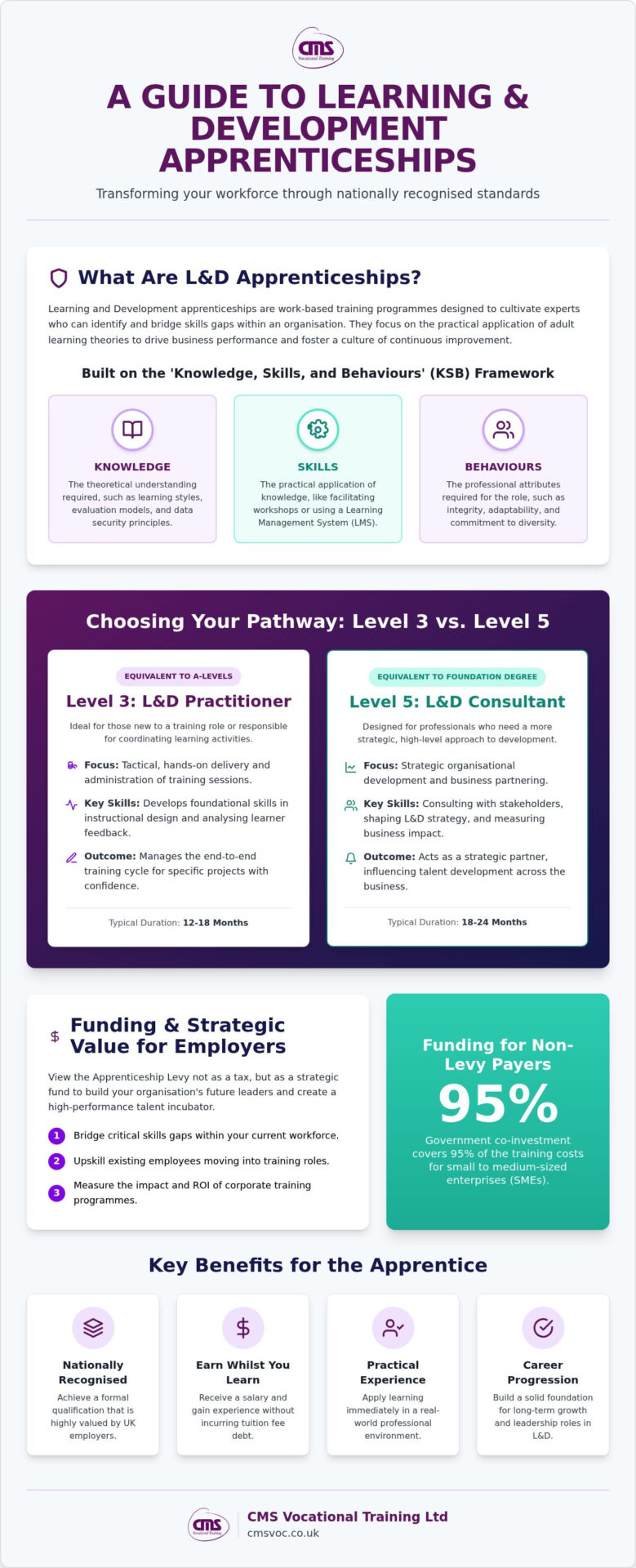
Learning and development apprenticeships are work-based training programmes designed to cultivate experts who can identify and bridge skills gaps within an organisation. Unlike traditional academic courses, these apprenticeships focus on the practical application of adult learning theories to drive business performance. They provide a structured environment where individuals learn to foster a culture of continuous improvement, ensuring that a workforce remains competitive and adaptable. The modern Apprenticeship system in the UK has evolved significantly, moving away from purely trade-based roles to include high-level professional qualifications like these.
At the heart of these programmes is the ‘Knowledge, Skills, and Behaviours’ (KSB) framework. This national standard ensures that every apprentice develops a consistent set of competencies. Knowledge covers the theoretical side, such as understanding different learning styles or data security. Skills involve the practical application, like facilitating a workshop or using a Learning Management System (LMS). Behaviours focus on the professional attributes required, such as integrity, adaptability, and a commitment to equality and diversity.
It’s a common misconception that these programmes are only for school leavers or new recruits. In reality, they’re an exceptional tool for upskilling existing employees who have moved into training roles without formal qualifications. Whilst they often sit within the same department, learning and development apprenticeships are distinct from general HR pathways. While HR focuses on the broader employee lifecycle and employment law, L&D is specifically dedicated to the growth, capability, and performance of people through targeted education. If you’re considering how these pathways compare, our guide to the hr apprenticeship career path provides a detailed roadmap from entry-level practitioner to HR Director.
The Core Role of an L&D Professional
An L&D professional acts as a strategic partner within a business. Their day-to-day responsibilities are varied and impactful. You’ll spend time analysing training needs across a diverse workforce to spot where performance can be improved. This leads to designing engaging digital and face-to-face learning interventions that resonate with different audiences. Most importantly, you’ll learn how to measure the impact and ROI of corporate training programmes, proving that development isn’t just a “nice to have” but a vital business investment.
Why Choose the Apprenticeship Route?
Choosing this route offers several clear advantages over traditional study. You’ll earn whilst you learn, receiving a structured salary without the burden of tuition fees. This financial stability is paired with immediate practical experience that a classroom-only course simply cannot provide. You don’t just read about training delivery; you actually do it in a real-world environment. Upon completion, you’ll achieve a nationally recognised qualification that is highly valued by UK employers, providing a solid foundation for long-term career progression.
Exploring the Standards: Level 3 and Level 5 Pathways
Choosing the right path in learning and development apprenticeships depends entirely on your current job role and where you want your career to go. There are two primary standards available: the Level 3 Practitioner and the Level 5 Consultant Business Partner. To put these into a familiar context, a Level 3 qualification is roughly equivalent to A-Levels, whilst Level 5 is comparable to a Foundation Degree. Both pathways provide a structured, professional framework for growth, but they cater to very different levels of responsibility within an organisation.
Typically, these programmes last between 12 and 24 months, depending on the learner’s prior experience and the specific requirements of the standard. If you are looking to start your journey through a Registered Apprenticeship program, it’s vital to assess the level of autonomy you have in your daily work. The Level 3 standard focuses on the tactical side of training, whereas Level 5 demands a more strategic, high-level approach to organisational development.
The Level 3 L&D Practitioner Standard
This standard is ideal for those who are either new to a training role or responsible for coordinating learning activities within a team. It focuses heavily on the delivery and administration of training sessions. You’ll develop foundational skills in instructional design, ensuring that learning materials are effective and engaging. A significant part of this level involves gathering and analysing learner feedback to improve future interventions. It’s a practical, hands-on qualification that builds the confidence needed to manage the end-to-end training cycle for specific projects.
The Level 5 L&D Consultant Business Partner Standard
The Level 5 standard is designed for experienced professionals who are ready to lead L&D strategy at a broader level. Unlike the delivery-focused Level 3, this pathway prioritises organisational development and long-term talent management. You’ll need to demonstrate the ability to influence senior stakeholders and manage complex budgets effectively. It requires a deep understanding of how learning aligns with business goals. If you’re currently in a role that involves consultancy and strategic planning, our learning and development apprenticeships can help you formalise your expertise and drive real change within your business.
The Strategic Value for Employers: Using the Apprenticeship Levy
How can you turn a mandatory tax into a high-performance engine for your business? For large employers with an annual paybill exceeding £3 million, the Apprenticeship Levy is a standard part of the UK tax landscape. However, many organisations still treat these funds as a lost expense rather than a dedicated training budget. Smaller businesses also have a significant advantage through the co-investment model. In this setup, the government pays 95% of the training costs, allowing SMEs to access high-level learning and development apprenticeships for a fraction of the usual price.
The “use it or lose it” nature of the Levy means that funds expire after 24 months if they aren’t allocated to a digital account. Reinvesting these funds into your L&D department is one of the most effective ways to ensure long-term stability. By training your own L&D practitioners, you build the internal infrastructure required to upskill the rest of your workforce. This strategic move reduces your reliance on expensive external consultants and recruitment agencies, keeping both knowledge and capital within your business.
Closing the Internal Skills Gap
Your L&D apprentices are uniquely positioned to identify future-critical skills, such as AI literacy and digital collaboration, before they become a bottleneck for growth. They help foster a culture of continuous improvement and lifelong learning amongst your staff. This approach is supported by the U.S. Department of Labor, which notes that the apprenticeship model is a proven way to improve workforce productivity. Additionally, offering funded career progression routes significantly boosts employee retention. When staff see a clear path for their own advancement, they feel more invested in the company’s success.
Maximising Your Training Budget
Transitioning from expensive, one-off workshops to sustainable apprenticeship programmes ensures that learning is embedded over time rather than forgotten in a week. CMS acts as your steady, reliable guide in this process, handling the administrative burden of the Levy so you don’t have to. We help you track the tangible ROI of your training, proving that a professional L&D department is a profit centre rather than a cost centre. By developing internal talent, you ensure your training budget delivers a lasting impact on your organisation’s performance.
How to Succeed: Balancing Work and Off-the-Job Training
Success in learning and development apprenticeships requires more than just technical ability; it demands effective time management and a supportive workplace culture. As of 2026, the requirement for off-the-job training is a minimum of six hours per week, calculated across the practical period of the apprenticeship. Crucially, this training must take place during your normal working hours. While this might sound like a significant commitment, it’s designed to ensure you have the dedicated space to grow without the pressure of your daily tasks interfering with your progress.
To integrate study into a busy schedule, we recommend a five-step process. First, block out recurring time in your calendar and treat it as an immovable meeting. Second, communicate clearly with your manager about when you’ll be offline. Third, align your learning with real-world business projects to make the training feel relevant. Fourth, document your activities as they happen to avoid a last-minute rush. Finally, attend all scheduled workshops to stay connected with your peers. This structured approach helps you maintain momentum throughout the typical 18-month duration of the programme.
What Counts as Off-the-Job Training?
Many learners are surprised by how much of their daily professional growth actually qualifies as training. Valid activities include shadowing senior colleagues during complex projects or attending industry conferences to stay updated on the latest L&D trends. Working on new initiatives that fall outside your usual duties is also a fantastic way to log hours whilst gaining practical experience. Additionally, time spent writing assignments, conducting research, and participating in CMS workshops forms the core of your theoretical development.
The Importance of Mentoring and Support
You aren’t expected to manage this journey alone. Every learner is supported by a dedicated CMS vocational tutor who acts as a steady, reliable guide. We facilitate regular tripartite reviews between the learner, the employer, and the CMS coach to ensure everyone is aligned on progress and goals. These meetings are essential for overcoming common challenges like “study-guilt” or managing tight deadlines. Building a strong relationship with an internal workplace mentor also provides a safe space to test new ideas before applying them more broadly.
The final stage of the programme is the End Point Assessment (EPA). This involves a professional discussion and a project presentation that demonstrates your mastery of the Knowledge, Skills, and Behaviours framework. We provide comprehensive preparation to ensure you feel confident and ready to showcase your achievements. If you’re ready to start your professional journey, you can enquire about our L&D standards today to find the right path for your career.
Why Partner with CMS Vocational Training?
Since our establishment in 1984, CMS Vocational Training Ltd has been a pillar of support for professional development across the UK. We bring over 40 years of experience to every partnership, ensuring that our learning and development apprenticeships deliver genuine, measurable value to both the learner and the business. Our philosophy is simple: we prioritise people over volume. This means every learner receives the individual attention they need to succeed, rather than being treated as just another number in a large-scale assessment process. We act as an experienced and nurturing mentor, guiding you through every step of the professional journey.
A Mentoring-Led Approach to L&D
We believe that the best way to develop future experts is through guidance and inspiration. Our tutors aren’t just assessors; they are industry professionals with real-world experience in the sector. They understand the nuances of the workplace and use that knowledge to teach and guide apprentices through every stage of the standard. Regular check-ins and tailored support plans ensure that no one is left behind, whilst also providing the flexibility needed to accommodate different learning styles. This nurturing environment allows apprentices to move beyond “tick-box” exercises and achieve true vocational excellence.
National Delivery and Long-Term Growth
For large, multi-site organisations, consistency is vital. Our national delivery model ensures that your staff receive the same high-quality training regardless of their location. This reliability makes us a trusted partner for businesses looking to standardise their L&D across multiple regions. Beyond learning and development apprenticeships, we offer a broader suite of professional qualifications, including Human Resources, Management, and AAT accounting. This variety allows you to create a long-term staff development plan that supports employees as they progress from entry-level roles into senior leadership positions.
Starting Your Journey with CMS
We act as your steady, reliable guide from the very first interaction. Our process begins with an initial consultation to ensure the right level is chosen for each specific job role, preventing the frustration of mismatched expectations. We also provide full support with the technical side of the process, including the Apprenticeship Service account setup and Levy management. This comprehensive assistance removes the administrative burden, allowing you to focus on what matters most: growing your team. Contact CMS Vocational Training Ltd today to discuss your L&D apprenticeship needs and discover how we can help you unlock the full potential of your workforce.
Building Your Future in Learning and Development
Investing in your professional growth through learning and development apprenticeships is a strategic move that pays dividends for both your career and your organisation. Whether you’re mastering the tactical delivery of the Level 3 standard or shaping high-level strategy at Level 5, these programmes provide the framework needed to excel in a skills-first economy. By effectively utilising your Apprenticeship Levy or the 95% government co-investment, you turn mandatory contributions into a powerful engine for internal talent development.
At CMS Vocational Training, we bring over 40 years of vocational training experience to every partnership. Our national coverage ensures that organisations across the UK receive consistent, high-quality support, whilst our specialist tutors provide the genuine industry expertise required to inspire and guide our learners. We don’t just assess; we act as a nurturing mentor through every stage of your professional journey.
Are you ready to transform your workforce or take the next step in your career? Discover our Learning and Development Apprenticeship programmes and see how our people-first approach can help you achieve your goals. Your path to vocational excellence starts with a single conversation, and we’re here to help you every step of the way.
Frequently Asked Questions
What is the apprenticeship minimum wage in 2026?
The apprenticeship minimum wage is reviewed annually by the government; the specific rate you receive depends on your age and which year of the programme you are in. For the 2026 period, it’s essential to check the latest figures on the official GOV.UK website as these rates typically increase every April. Many employers choose to pay significantly more than the legal minimum to attract and retain high-quality talent within their business, recognising the value of professional growth.
Can an existing employee start a learning and development apprenticeship?
Yes, existing employees can certainly enrol on learning and development apprenticeships to upskill or move into a new role. This is a popular way for organisations to formalise the expertise of staff who are already performing training duties but lack a recognised qualification. As long as the programme provides significant new learning that is relevant to your job, you can access the same government funding as a new recruit to support your professional advancement.
How long does a Level 5 L&D Consultant apprenticeship take to complete?
A Level 5 L&D Consultant Business Partner apprenticeship typically takes between 18 and 24 months to complete. This duration allows enough time for you to master complex strategic skills and gather the evidence required for your final assessment. The exact timeframe often depends on your prior experience and the specific needs of your organisation. We work with you to create a steady, manageable pace that balances professional growth with your daily responsibilities and career goals.
Do I need specific GCSEs to apply for an L&D apprenticeship?
Most learning and development apprenticeships require you to hold GCSEs in English and Maths at Grade 4 (C) or above. If you don’t already have these qualifications, don’t worry; you can often complete functional skills training alongside your main apprenticeship. We provide the necessary support to help you achieve these essential credentials, ensuring you have the solid academic foundation needed to progress through the higher levels of vocational training and reach your full professional potential.
What is the difference between a CIPD qualification and an L&D apprenticeship?
A CIPD qualification is a professional certification from the Chartered Institute of Personnel and Development, whilst an apprenticeship is a government-funded training standard based on practical workplace application. Many of our programmes are designed to align with professional standards, providing a more hands-on route to expertise. The apprenticeship focuses on the Knowledge, Skills, and Behaviours required for the role, often offering a more comprehensive, funded pathway than a standalone course or private training programme.
Is there an age limit for starting an apprenticeship in the UK?
There is no upper age limit for starting an apprenticeship in the UK. As long as you are over 16 and not in full-time education, you are eligible to apply. This makes apprenticeships an excellent option for career changers or established professionals looking to gain new qualifications later in life. We see learners of all ages successfully completing our programmes, proving that it’s never too late to invest in your personal and professional advancement through vocational training.
How much of my time will be spent on ‘off-the-job’ training?
You will spend a minimum of six hours per week on off-the-job training, which must take place during your normal working hours. This time is specifically dedicated to learning new skills that are not part of your usual daily duties. Activities can include attending CMS workshops, conducting research, shadowing senior colleagues, or working on new projects. This structured approach ensures you have the necessary space to focus on your development and professional growth without distracting from your core role.
What happens if I don’t pass my End Point Assessment (EPA)?
If you don’t pass your End Point Assessment (EPA) on the first attempt, you will have the opportunity to resit or retake the relevant sections. Your CMS vocational tutor will act as a steady guide, helping you identify areas for improvement and providing additional coaching to build your confidence. We are deeply invested in your success and will work closely with you and your employer to ensure you are fully prepared for a successful second attempt at your assessment.
