

£2,000 Apprenticeship Hiring Incentive: What Employers Need to Know for October 2026
CMS Vocational Training posted this on Wednesday 16th of September 2026 CMS Vocational Training 16/09/2026

The £2,000 apprenticeship hiring incentive could help eligible non-levy employers in England recruit a new apprentice from October 2026. Hiring the right person is rarely simple for small and medium-sized employers. You may be dealing with rising recruitment costs, a limited candidate pool, skills gaps in key roles, or the pressure to bring someone in who can contribute quickly without stretching the team.
For employers in England that do not pay the apprenticeship levy, a new government hiring payment may make the decision to recruit an apprentice more attractive from 1 October 2026. But the real value of an apprenticeship is not the payment itself. The long-term benefit is the chance to build capability in a role that matters to your business, with training shaped around your needs.
If you are planning to recruit a new employee aged 16–24, this is a good time to consider whether an apprenticeship could help you secure the skills you need while keeping recruitment purposeful and practical. apprenticeship support for employers
What is the £2,000 apprenticeship hiring incentive?
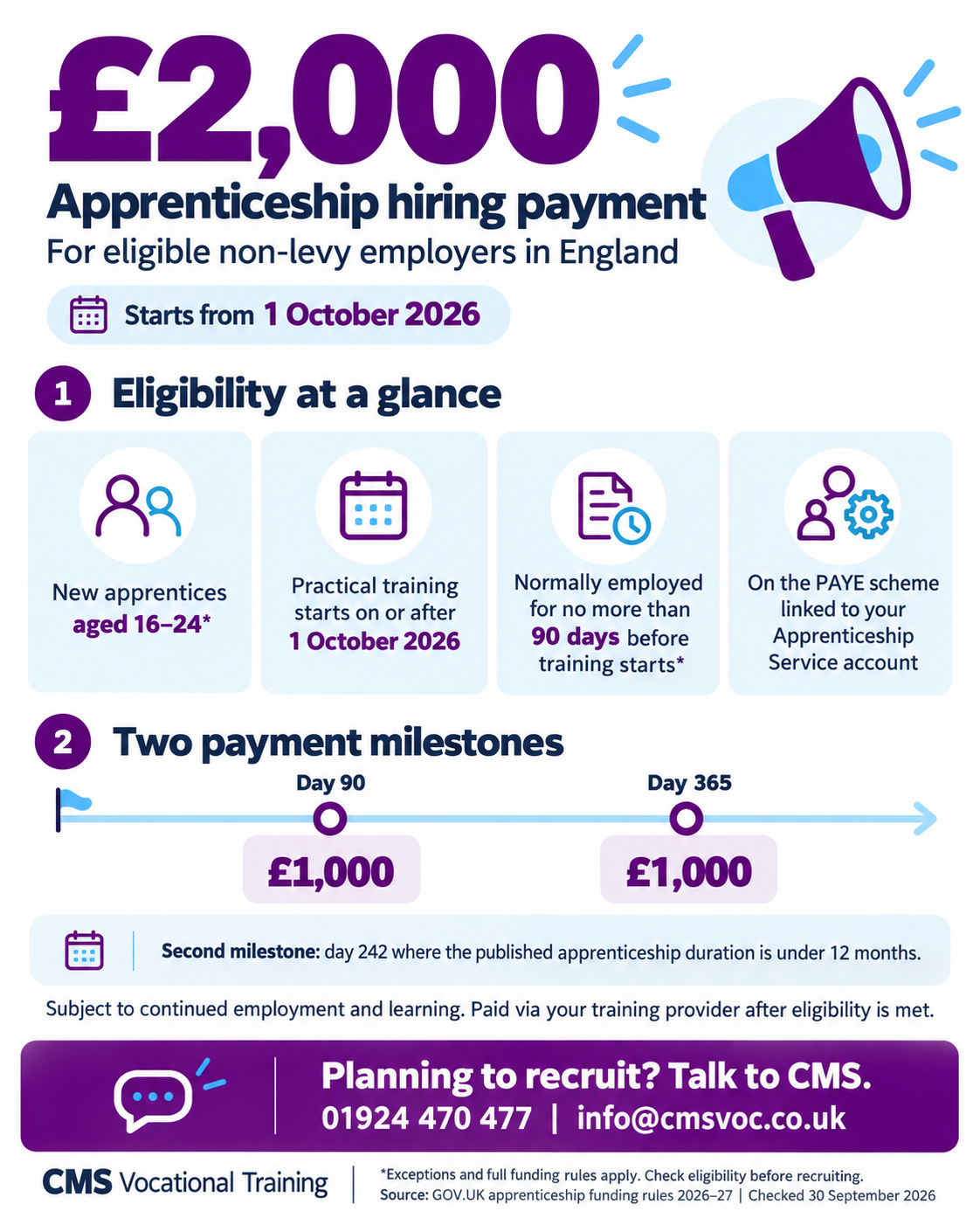
From 1 October 2026, eligible non-levy employers in England can receive an apprenticeship hiring payment of up to £2,000 when they recruit a new apprentice aged 16–24.
This is an employer payment rather than a discount on training costs. It is designed to support recruitment and encourage employers to take on apprentices who are starting out in work-based training. The payment is claimed by the training provider and passed on to the employer.
The key point for employers is that this incentive can reduce the initial cost of hiring. It does not replace the need for a well-planned apprenticeship role, strong supervision or a genuine business need.
Who is likely to qualify?
The apprenticeship hiring incentive has several conditions. Employers should check the official apprenticeship funding policy and applicable funding rules before they recruit.
An apprentice must:
- be aged 16–24 when apprenticeship training starts
- have an apprenticeship agreement with a practical-period start date on or after 1 October 2026
- not have worked for the employer for more than 90 days before the practical-period start date
- be included within the PAYE scheme linked to the employer’s Apprenticeship Service account
The employer must also be eligible under the relevant government funding rules. In practice, this means the payment is aimed at eligible non-levy employers rather than every organisation.
A simple way to think about it is this: if you are recruiting someone new and want to hire them as an apprentice, the incentive may be relevant. If the person has already been employed by you for more than 90 days before the apprenticeship start date, they would not qualify for this particular hiring payment, although their apprenticeship may still be eligible for training funding.
Practical example
Suppose you are a small employer recruiting an administrator aged 19 who has not worked for you before. If the apprenticeship starts on or after 1 October 2026, and the other conditions are met, the new hiring payment may apply.
Now consider an existing staff member who has been with you for four months and wants to start an apprenticeship. That apprenticeship could still be a valuable development route, but the new hiring payment would not apply because the person has been employed for more than 90 days before the start date.
How is the £2,000 payment paid?
The government’s payment timetable sets out two instalments of £1,000:
- after day 90
- after day 365, or day 242 where the apprenticeship lasts under 12 months
That means the first payments will not be available immediately. Based on the payment timetable, the earliest first payments will therefore be available from January 2027.
For employers, that timing matters. The payment should be seen as support that follows a successful start, not as an up-front grant that removes the need for planning.
What training costs are funded separately?
The apprenticeship hiring incentive is only one part of the picture. For new apprentices aged 16–24, the government funds 100% of eligible training and assessment costs, up to the funding band maximum.
This separate funding can make apprenticeships much more manageable for employers, especially when you compare them with the wider cost of external recruitment or replacing a skill you do not yet have in-house.
That said, funding rules still apply. Final eligibility is subject to the relevant government guidance, and employers should not assume that every course, every apprentice or every support measure will automatically qualify.
Can employers receive more than one type of support?
In some cases, yes. Employers may qualify for more than one form of support, depending on the apprentice and the scheme.
For example, an eligible apprentice aged 16–18 could potentially attract the new £2,000 payment and the existing £1,000 additional payment, producing up to £3,000 in employer payments.
However, it is important not to assume that all forms of support can always be combined. Additional schemes, including Foundation Apprenticeship incentives and Youth Jobs Grants, have separate eligibility requirements.
If you are hoping to use more than one payment or incentive, the safest approach is to check the rules for each scheme before you recruit.
Why do apprenticeships still matter if the incentive is only £2,000?
The payment is helpful, but the wider business case for apprenticeships is usually stronger than the immediate financial incentive.
A well-managed apprenticeship can help employers:
- recruit for potential rather than relying only on experience
- address skills shortages in hard-to-fill roles
- develop role-specific competence inside the business
- improve succession planning
- attract younger talent into the organisation
- diversify the workforce
- create a sustainable workforce-development pipeline
For many employers, the real value is that apprenticeship training supports the kind of employee your business actually needs. Instead of hiring someone who may or may not fit, you bring in a person with the right attitude and develop the skills together.
That can be especially useful in small teams, where every hire matters and each role may need a tailored mix of knowledge, judgement and practical skill.
What does a good apprenticeship need from the employer?
To work well, an apprenticeship should be a genuine job with real duties and real development.
As an employer, you need to provide:
- a proper role with meaningful work
- supervision and day-to-day support
- time for off-the-job training
- chances to practise new skills in the workplace
- regular feedback and progress review
- a workplace environment that helps the apprentice learn and improve
Off-the-job training is not a side issue. It is part of the apprenticeship and needs to be planned into working time. If the role is rushed, unsupported or poorly structured, the apprentice is less likely to develop in the way your business needs.
A successful apprenticeship is therefore not just about hiring. It is about workforce development.
How CMS can help employers recruit and support an apprentice
If you are considering recruiting an apprentice, CMS Vocational Training can help you turn the idea into a workable plan.
CMS Vocational Training offers employer support that can include:
- free apprentice recruitment
- help selecting the right apprenticeship for the role
- advertising your vacancy
- identifying applicants
- reserving funding where appropriate
- setting up the apprenticeship
- supporting both employer and apprentice throughout the programme
CMS also provides fully online apprenticeship delivery across England, which can be helpful for employers who want a national solution with structured support. Regular tutor contact, dedicated employer account management and progress reviews can help keep the programme on track.
If you are recruiting in areas such as business administration, human resources, learning and development or accountancy, CMS has relevant apprenticeship programme pages that may be useful when you are exploring the best fit for your vacancy. For example:
- business administration and management apprenticeships
- human resources apprenticeships
- learning and development apprenticeships
- AAT accountancy apprenticeships
The important thing is to match the apprenticeship to the job, not the other way around.
Questions employers should ask before recruiting
Before you take the next step, it is worth asking:
- Is this a real vacancy with clear duties?
- Could the role be developed through an apprenticeship?
- Will the apprentice be between 16 and 24 when training starts?
- Has the candidate been employed by us for more than 90 days already?
- Are we eligible as a non-levy employer under the rules?
- Can we give enough time, support and supervision for the apprentice to progress?
If the answer to most of those questions is yes, an apprenticeship may be a strong option.
FAQs
How much is the new apprenticeship hiring payment?
Eligible employers can receive up to £2,000.
Who can claim it?
Eligible non-levy employers in England, provided the apprenticeship meets the published conditions.
What age must the apprentice be?
The apprentice must be aged 16–24 when apprenticeship training starts.
Can I claim it for an existing employee?
Not if they have worked for you for more than 90 days before the practical-period start date. Their apprenticeship may still be eligible for funding.
When are the payments made?
In two instalments of £1,000, after day 90 and day 365, or day 242 if the apprenticeship lasts under 12 months.
Is training funded as well?
Yes. For new apprentices aged 16–24, the government funds 100% of eligible training and assessment costs, up to the funding band maximum.
How can CMS help?
CMS can help you choose the right apprenticeship, advertise the vacancy, identify applicants, reserve funding, set up the apprenticeship and support the employer and apprentice throughout the programme.
Final thought
If you are planning to recruit someone aged 16–24, the new £2,000 apprenticeship incentive for 2026 could help reduce the cost of hiring. But the lasting value of an apprenticeship comes from building a capable employee whose skills fit your business.
If you would like help deciding whether an apprenticeship is right for your vacancy, contact CMS before you recruit. The team can talk you through eligibility, funding and free recruitment support so you can make an informed decision from the outset.
Call 01924 470 477 or email info@cmsvoc.co.uk.
